
A shorter version of an article first published at iyersellmer.com, where the full piece, charts and sources are available.
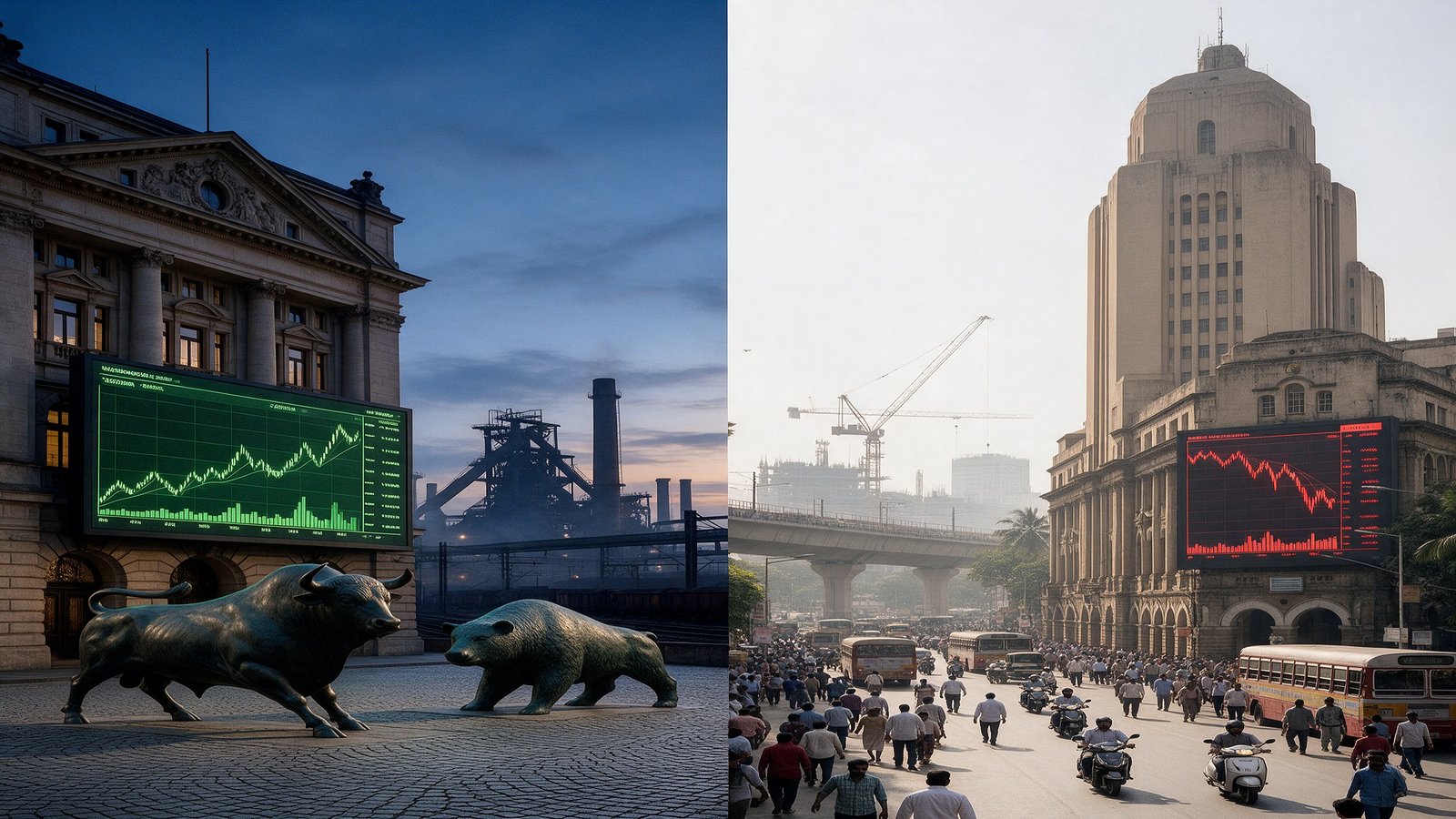
Germany has a stock market that keeps setting records over an economy that has barely grown since 2022. India has the opposite problem. The economy grew 7.8% in April to June, faster than economists expected, with investment up almost 12%. The Nifty 50, meanwhile, closed at 25,255.05 on 11 November, still about 3% below where it began the year. In mid-October it was down almost 14%.
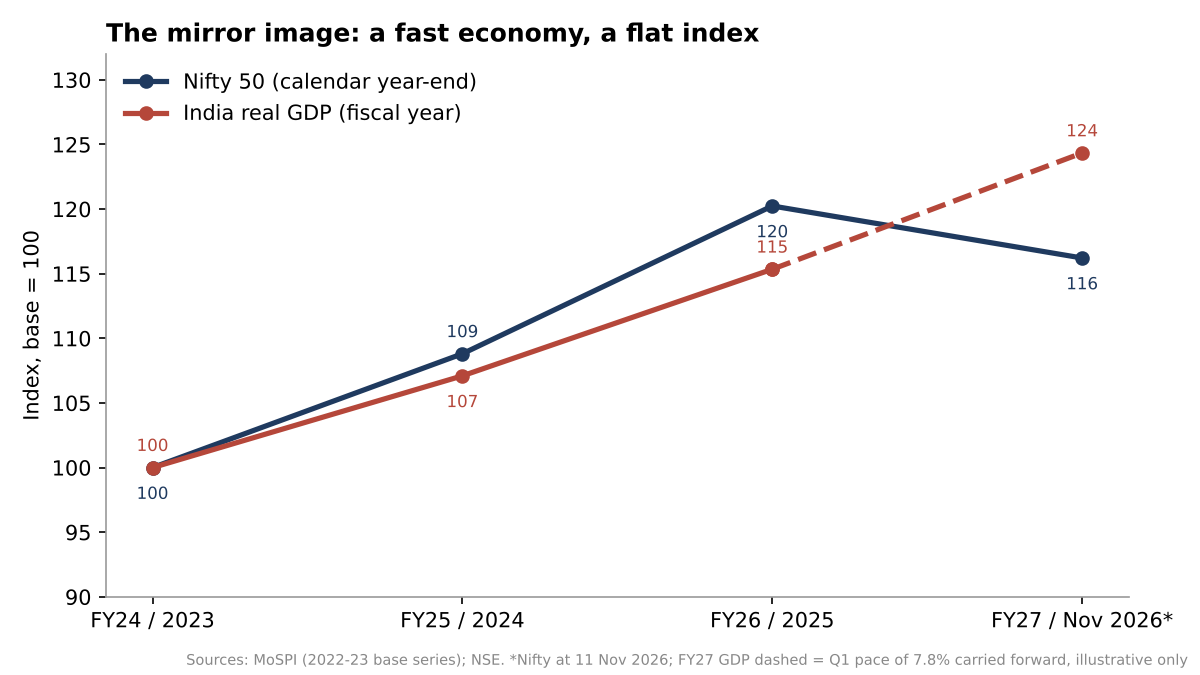
The German explanation doesn’t travel. Around 82% of DAX companies’ sales are earned abroad, so the DAX can prosper while Germany stalls. The Nifty is the reverse: outside IT services it is almost entirely a bet on Indian borrowers, consumers and fuel demand. If any index ought to follow its home economy, it’s this one.
For a while, the growth wasn’t inside the index
For the January to March 2026 quarter, Business Standard found that Nifty 50 adjusted profits grew just 4.5%, the eighth straight quarter of single-digit growth, while profits across all 3,081 listed companies grew 15.1%. Here Germany runs backwards. The DAX shed its sick sectors, and carmakers are now a sliver of it. The Nifty is stuck with its tired ones. Financials are 37% of the index; capital goods, the obvious capex beneficiary, is 1.2%.
I have to concede that index earnings have since caught up a good deal: up 18% in April to June and about 22% for the companies that had reported July to September by the end of October, according to Motilal Oswal. The broader market is still growing faster. But the Nifty fell in August and September with those numbers already out. Whatever was setting the price that summer, it wasn’t the profit numbers.
Expensive going in, and foreigners going out
India entered 2025 expensive and has been re-rated down; even after the recent rally the Nifty’s P/E was 20.48 on 9 November, below its five-year median of about 22. By mid-October foreign portfolio investors had pulled out more than ₹3 trillion in 2026, a record, with US 10-year yields above 5.2%, Brent around $105 and the rupee near 95 to the dollar. India also has almost no listed AI-hardware plays, so global money went to Korea and Taiwan instead.
Ownership runs the other way from Germany too. Foreigners own 52.6% of the DAX. In India, FPI ownership is down to 16.13%, a 14-year low, while domestic institutions are at a record. Indian SIP money (a record ₹32,490 crore in September) is, in my view, why the Nifty fell 14% at its worst rather than 30%.
Then November turned it round
After the US midterms on 3 November, markets began to price tighter rules on AI data centres. In the week to 6 November Korea’s Kospi fell 13.6% and Taiwan’s benchmark 11.6%; the Nifty rose 6.8%. Foreign investors bought a net ₹53,739 crore of Indian shares between 2 and 9 November. India’s lack of AI exposure, which hurt it for eighteen months, suddenly helped. I wouldn’t read much into one good fortnight. But no new GDP figure came out that week; what changed was who wanted to buy.
Is this a spoiler for FDI?
Not for the factory builder. Net FDI looked awful in FY26 at $7.7 billion, against $28 billion in FY23, but gross inflows hit a record $94.5 billion and India ranked second in the world for greenfield announcements. The net figure was small because $53.6 billion went out as repatriation and disinvestment, much of it private equity and foreign parents cashing out of a hot market. This year net FDI is recovering: $13.8 billion in April to August, against $9.6 billion a year earlier.
Where it does bite is on the rupee and the balance of payments. In April to June the current account deficit was $4.2 billion while portfolio investors took out $9.6 billion, and reserves fell. Private equity, much of which counts as FDI, also prices its entry off the exit it expects.
What would help
The government is reportedly weighing a cut to capital gains tax before the 2027-28 Budget; a promise to keep the rate stable afterwards would matter more than the cut. The February trade framework’s 18% US tariff was never applied, and most Indian goods now pay a 10% Section 301 duty with no deal signed; a signed agreement would remove one discount. More listings that raise fresh capital for manufacturing and energy, rather than pure stake sales, would slowly change the shape of the index. And bond index inclusion, deferred again by Bloomberg in July, would bring patient money that steadies the rupee.
For investors, the advice I gave on the DAX applies in reverse. Don’t read the Nifty 50 as India’s scorecard; look at the Nifty 500, credit growth, GST collections and capex numbers. Gaps like these close eventually, and in early November India’s began to close from the market side. I know which of the two I’d rather start from. When, I won’t pretend to know.
The full version, with charts, comparisons with China and the US and a complete source list, is at iyersellmer.com. This is a personal analytical piece, not investment advice.