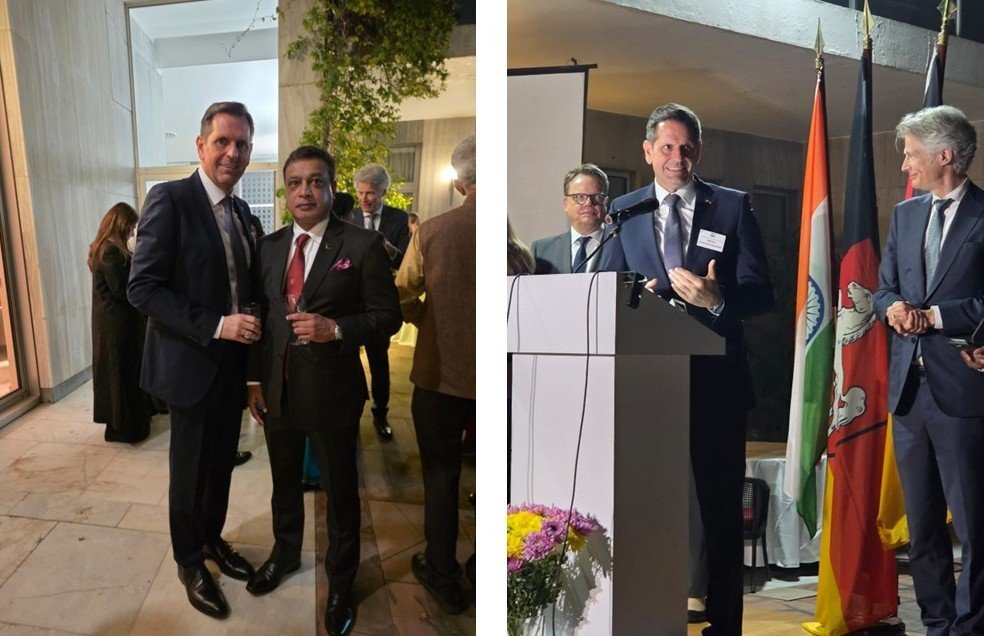
It was a good evening at the German Embassy in New Delhi. Receptions for visiting dignitaries can easily become a polite exchange of business cards and not much else, and this one for Olaf Lies, Minister President of Lower Saxony, didn’t feel like that at all. Lies has brought around sixty people from politics and business, which is a large group for a German Land, and a genuinely mixed one: the automotive industry and its suppliers, machine builders, people from the digital and AI side, renewable energy, and those working on the skilled-worker question. What struck me more was the Indian side of the room. A lot of people came, from a wide spread of sectors, and they stayed to talk shop rather than drifting off after the speeches.
On the Indian side, it was good to spend time with Mr V. N. Shiva Shankar and Mr Vinod Solomon, President and Secretary General of the Southern India Chamber of Commerce and Industry, who are travelling with the delegation. SICCI was founded in Chennai in 1909 and comes from my home state, Tamil Nadu. It took its own business delegation to Saxony and Lower Saxony in April, so for SICCI this week has something of a return visit about it.
It was also a real pleasure to renew my acquaintance with Dr Jasper Wieck, who took over as Germany’s Ambassador to India in August. We last met in Berlin. He was then the Political Director in the Bendlerblock, heading the policy division of the Federal Ministry of Defence and serving as the minister’s political adviser, and I was India’s Defence Attaché. An ambassador in Delhi who knows the security side of this relationship from the inside is no small asset, given how seriously defence cooperation is now taken on both sides. But this week is about trade, so let me stay with trade.
What Hannover is actually here for
The State Chancellery’s own description of the trip, which runs from 22 to 28 November, is more specific than these things usually are. In New Delhi there are political talks with the Indian government and sessions with the Embassy, the Indo-German Chamber of Commerce and Germany Trade & Invest on what the EU-India FTA will mean in practice. There is also a meeting with officials from Telangana on recruiting and training skilled workers, including under the new EU-India framework on mobility.
Then it’s Pune, India’s automotive and supplier hub: Škoda Auto Volkswagen India and the Volkswagen Academy, nass magnet India (a mid-sized firm from Hannover), and GARGI Hüttenes-Albertus. Then Mumbai: Ottobock, BASF’s innovation site, and a session with NASSCOM on industrial AI, smart production, cybersecurity and digital tools for small and mid-sized companies, with the stated aim of starting joint projects.
Lies calls India one of the world’s most important growth markets and says the FTA could become a “real milestone”. He also made a point that I think is the more interesting one: India matters to Lower Saxony as a partner for innovation, digitalisation and industrial transformation, and not only as a place to sell things. Hold on to that. It shapes most of what follows.
Why Lower Saxony, of all the Länder
Bavaria and Baden-Württemberg usually get the attention when Germany and India talk business, and fairly so; they have the numbers. But Lower Saxony has a few things the southern states can’t offer, and several of them line up neatly with what India needs.
Start with Hannover itself. The Hannover Messe is the world’s leading industrial trade fair, and India has been its partner country twice, in 2006 and again in 2015, when Modi and Merkel opened it together. For a good many Indian engineering firms, Hannover was their first real look at German industry at scale. That familiarity counts for something.
Then energy. According to the state government, Lower Saxony produces more electricity from onshore wind than any other German state, and roughly 1,800 km of Germany’s planned hydrogen core network runs through it. India, for its part, was described only this June by Wieck’s predecessor, Philipp Ackermann, as having emerged as a global leader in renewable energy. A state that has spent two decades building turbines, grids and now hydrogen pipelines has something specific to offer, and plenty to learn about doing it at Indian scale and Indian cost.
There’s the sea. Wilhelmshaven’s JadeWeserPort is Germany’s only deep-water container port, able to take the largest container ships regardless of the tide. For trade that moves by sea between the North Sea and the Arabian Sea, that is a practical asset, not a talking point.
And there is groundwork already done, more than most people realise. Volkswagen, Continental, Sartorius and Ottobock are all Lower Saxony companies. The state set up a German-Indian Business Center in Hannover with hannoverimpuls back in 2007, which now counts a network of over 4,000 Indian companies interested in Germany. The IHK Hannover has run an India Desk since 2008, and the state keeps its own representative in Mumbai. None of that is glamorous. All of it means an Indian firm looking for a European base, or a Lower Saxony firm looking at India, doesn’t start from zero.
The sceptic in Hannover has a point
Let me put the case against first, because a family-firm owner in Osnabrück or Celle would be entitled to make it, and parts of it are simply correct.
The FTA isn’t in force. Negotiations concluded on 27 January 2026, after close to two decades of on-again, off-again talks, and that was a real achievement. But conclusion isn’t signature, and signature isn’t entry into force. India’s Commerce Secretary Rajesh Agrawal has said the target is to sign in December. The Commission sent its proposals to the Council in September; after signing, the European Parliament still has to give consent, the Council has to take a final decision, and India has to complete ratification. At the end of October the MEA was still describing the text as undergoing legal scrubbing. The EU’s Ambassador in Delhi, Hervé Delphin, has spoken of having it operational in the first half of 2027. So we are some months away at best.
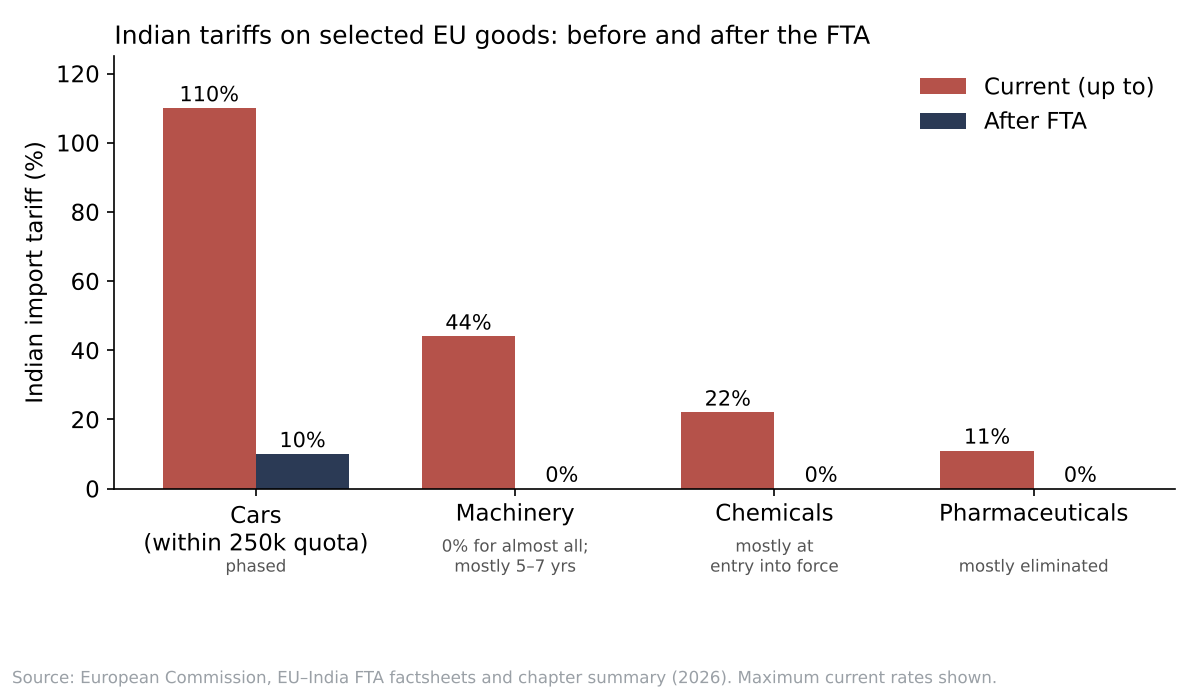
Much of the tariff relief is staged. Indian tariffs on machinery of up to 44% go to zero for almost all products, but over periods of up to ten years, mostly five to seven. Car parts take five to ten years. Cars come down from 110% to 10%, but only within an annual quota of 250,000 vehicles.
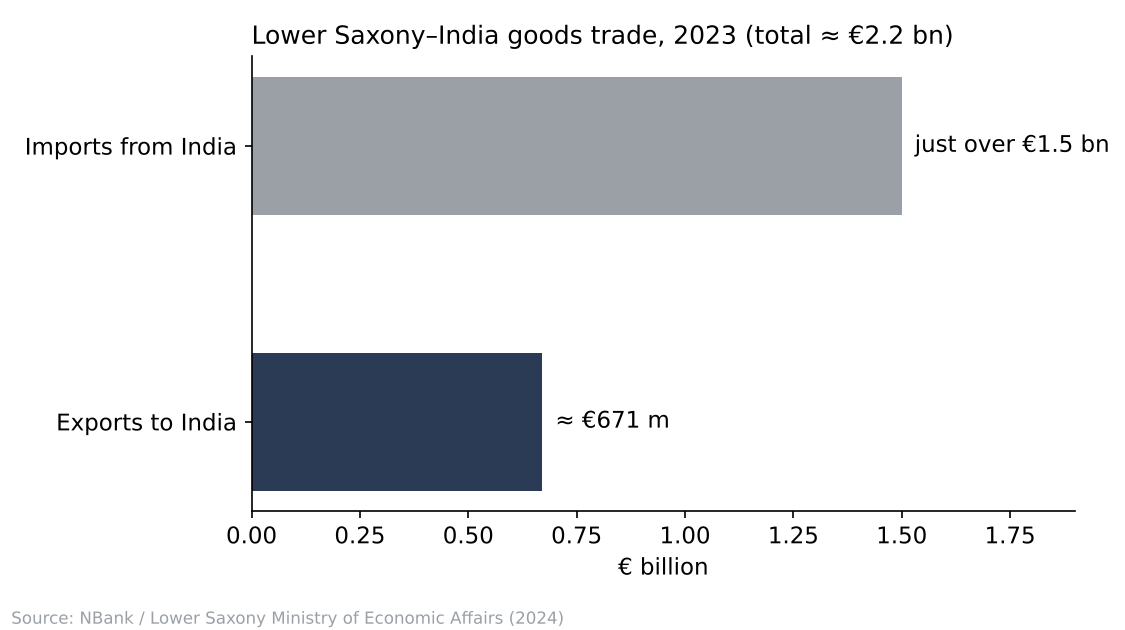
And Lower Saxony doesn’t actually sell much to India yet. In 2023 total trade between the Land and India came to about €2.2 billion, which ranked India 23rd among Lower Saxony’s trading partners. Just over €1.5 billion of that was imports from India. Exports from Lower Saxony to India were around €671 million. For the home state of Volkswagen, Continental and Ottobock, that is a modest number.
All three points are fair. I just don’t think they lead where the sceptic thinks they lead.
Why the waiting period is the opportunity
Take the staging. A tariff that falls over five to seven years is not an invitation to wait five to seven years. It is the window in which a machine builder sets up a service network, finds an Indian partner, perhaps starts local assembly and builds a sales team, so that when the duty finally reaches zero the firm is already known to the customer and already price-competitive. Whoever waits for the last tariff cut will find competitors from other EU member states, with exactly the same access, sitting in the buyer’s office ahead of them. Indian buyers, public or private, tend to reward people who have been around for a while and have been patient. They are much less kind to those who fly in once a year with a brochure.
The trade imbalance is, oddly, the most encouraging number of the lot. That €1.5 billion of imports tells you Indian suppliers already work well for Lower Saxony’s industry; those supply chains exist and function. What’s missing is the reverse flow, and that is where the agreement bites hardest. According to the Commission, India’s tariffs on industrial goods currently average above 16%, and the deal removes far more friction for European exporters entering India than the other way round. The gap in Lower Saxony’s figures is roughly the space the FTA opens up.
The national picture says the same thing more loudly. German-Indian trade reached a record US$35.4 billion in 2025, up about 6%, according to Destatis figures compiled by GTAI. But German exports grew by just 0.6% to $18.4 billion, while imports from India rose 12.5% to almost $17 billion. Germany’s surplus with India is now less than half of what it was a year earlier. India is getting better at selling to Germany faster than Germany is getting better at selling to India, and for German industry the FTA is the most obvious way to correct that.
So where should the Mittelstand look?
The itinerary of this trip is, as it happens, a decent map.
Machinery and components first, because it’s the obvious one. Machinery is already Germany’s largest export to India, over $5 billion in 2025 and about 28% of the total, and the VDMA reported machinery exports to India up 8.5% in the first quarter of 2026. Tariffs of up to 44% are what come down. The real decision for a mid-sized machine builder is whether to keep shipping complete machines or to assemble in India. The agreement builds transition periods into the rules of origin for machinery precisely to encourage local manufacturing, so that question deserves a proper session with a trade lawyer before anyone books a flight.
Process chemicals and industrial materials get talked about less, and I think they deserve more attention. Chemical tariffs of up to 22% are to be removed mostly at entry into force, not years later. BASF and Hüttenes-Albertus, a foundry-chemicals business, are on the itinerary for a reason. A smaller Lower Saxony firm supplying coatings, foundry materials or specialty inputs to India’s expanding manufacturing base would feel the benefit sooner than almost anyone else.
The auto supply chain, but with eyes open. Pune is where the German car industry in India lives, and the Volkswagen visit makes sense. I would be honest with any supplier, though. Car-parts tariff relief is among the slowest in the agreement, and German automotive is going through a painful transformation at home that the trip itself acknowledges. The more promising angle may well be engineering, tooling and components made in India with Indian partners, for India and for export, rather than parts shipped from Lower Saxony and waiting a decade for the duty to disappear.
Medical technology, which is where Ottobock comes in. The Commission names medical devices among the EU sectors with strong gains from the deal, and a market of 1.4 billion people does not need its scale explained.
Industrial AI and software, as partners and not as customers. The NASSCOM session is the part of the programme that fits Lies’s “not just a sales market” line most closely. Lower Saxony has factories, process knowledge and a large engineering Mittelstand. India has software engineering at a scale Germany cannot match. Smart production, cybersecurity for industrial systems and digital tools for SMEs are joint-venture territory, and the FTA’s digital trade chapter is meant to give e-commerce and digital service delivery more legal certainty.
Renewable energy is on the list as well, with the political backing of the Partnership for Green and Sustainable Development that Scholz and Modi signed in May 2022.
And then there’s people, which may turn out to be the most immediately useful item of the week. The Telangana meeting on recruiting and training skilled workers, under the new EU-India mobility framework, speaks directly to the Mittelstand firm in rural Lower Saxony that cannot fill its vacancies. I’d watch what comes out of that one closely.
A few cautions, since I’d be doing nobody a favour without them
The calendar can slip. Trade agreements of this size have a way of finding new obstacles between conclusion and ratification, and nobody should build a business plan around a December signing as though it were already done.
The Commission counts 13,347 German companies already exporting to India. The agreement’s chapter for small businesses, with dedicated contact points on both sides, is meant to help more of them join that number. Contact points are useful. They don’t do the market work for you.
And India is not a market anyone cracks on a single delegation trip, however well organised. The visits, the speeches and the embassy reception are the easy part. Whether Lower Saxony’s €671 million becomes something rather larger in five years depends much less on the Brussels calendar than on how many of the people in that room come back in six months, on their own, without a Minister President to open doors for them.
I hope a good number do. If you run a Mittelstand firm that has looked at India and decided against it, I’d genuinely like to hear what held you back.
Figures from the Lower Saxony State Chancellery and Environment Ministry, NBank, Deutsche Messe, NPorts, hannoverimpuls, the European Commission (DG Trade), GTAI/Destatis, the VDMA via GTAI, and reporting by ANI and ThePrint. Trade figures for Lower Saxony are for 2023, the latest available in the state’s published material.